Forbes Magazine has some fantastic articles on entrepreneurship which are worth catching up on every week.
During the last few days, there have been some exceptionally informative ones on easy businesses to start, teaching entrepreneurship and trends from Silicon Valley.
However, I do enjoy the articles from Paul. B Brown and his latest one, summarising the lessons he has learnt from a lifetime of entrepreneurship,
I wouldn't agree with everything on the list, it is a good place for those who want to launch a new business to start. So what are his 23 lessons for entrepreneurs.....
1. The best way to predict the future is to create it.
2. The most important decision you can make is…where do you want to spend your time. You only have so much time, energy and ability to focus. That means, as much as you would like to, you can’t do everything. That’s a given. So is this: The places which receive your full attention will do better than the places that won’t. What follows from that is this: You need to make hard choices about what you will do–and what you won’t. And it is really is the important decision you can make, because everything else you do will flow from it…including the next point.
3. If you want to be a successful entrepreneur, there is no such thing as work-life balance. I am not advocating that you spend a disproportionate part of your life working on your company. (I am also not advocating against it.) I am simply reporting that is what the most successful entrepreneurs do. I have never found an exception.
4. The best entrepreneurs don’t come up with great ideas, they solve market needs. You and I can come up with wonderful ideas all day long but unless they satisfy a large enough need, one that can support a business, they don’t do anyone any good.
5. The one thing all successful entrepreneurs have in common is the desire to make their idea a reality. What entrepreneurs need most of all—above motivation, focus, hope, financing, marketing skills, a brilliant idea, etc.—is the will to bring their idea into existance. Unless you truly want to make something happen, the odds are nothing will. Without that desire, nothing else matters…or occurs. Your life will be filled in other ways.
6. Action trumps everything. Stop thinking and get underway.
7. Take small, smart steps towards your goals. Contrary to the popular press, the most successful entrepreneurs are not swing-for-the-fences, bet-everything-on-one-roll-of-the-dice types. They are extremely conservative. They take a small step toward their goal; pause to see what they have learned from taking that small step and build that learning into the next small step. Then they pause to see what they have learned from that second small step, build that learning in and then take another small step and so forth. They don’t take large risks.
8. If you want to build a successful company give up control. You can try to micromange but: the business will never grow bigger than one person (you, the CEO) can handle effectively; the company won’t be able to move very quickly. Since everything will have to flow through you, you will create a bottleneck; you won’t get the best ideas out of your people. Once they understand the company is set up so everything revolves around you, people are not going to take the time to develop their best ideas. “Why should I,” they’ll ask. “He is just going to do what he wants anyway.” And it’s exhausting.
9. Forget about working on your weaknesses, play to your strengths. This is what will make you successful in the long-run.
10. You need to be able to turn every obstacle into an asset. Yes, every single one.
11. All you need to know about marketing in exactly 30 words? Marketing, when you strip everything away, is extremely simple: You figure out who you want to sell to, and then you determine what it is that will get them to buy.
12. Here’s the only market research you need: Get your product out in the marketplace and see if it sells.
13. If you insist on doing market research anyway, here’s the one question you need to ask. Show potential customers a prototype, or describe the service you are thinking of offering and then say: ”Is this something you would buy,” and if they answer yes, ask for the order then and there. If, as the cliché goes, they are willing to put their money where their mouth is, you are probably on to something. If they aren’t, you still have work to do.
14. You must figure out how you are going to collect what you are owed. Nobody thinks about this before they get underway and suddenly they learn first hand what they phrase “cash flow crunch” means.
15. As much as you are going to fight it you need a (really smart) advisory board. You want a board to: give you new perspectives and ideas; to give you people to talk to and to provide honest feedback.
16. If you want to get more done faster and better…create checklists. Checklists are a wonderful way to make sure you don’t overlook anything, and that it is true whether we are talking about the best way to treat someone in the emergency room or if you are about to make a big presentation to a client you really want to land.
17. How to motivate yourself and stay motivated. Starting anything new is hard and the number of obstacles you are going to encounter can easily get overwhelming. Click on the link here for proven ideas that can keep you going.
18. If the dogs don’t like the dog food it’s bad dog food. You don’t determine what a good product is. Only your customer does. And if they don’t like your product, it’s a bad product. Period. In others words, the customer is always right. Darn it.
19. If the customer doesn’t like the product, there isn’t much you can do about it with pricing or promotion or positioning. Unpopular products are going to remain so. It is better to come up with a different version, than to keep trying to sell–at a discounted price–the one people don’t like.
20. If you are going to fail, and sometimes you will, fail quickly and cheaply. Always take small steps toward your goal and pause after each one to make sure you are staying on the right track.
21. (Really) Learn from your mistakes. You are going to make mistakes. That’s a) a given and b) okay, providing you truly understand what went wrong.
22. Creativity and innovation must be linked to a business objective. Creativity is wonderful. But creativity that isn’t tied to making money is just a hobby. It isn’t a viable business concept.
23. Get while you still have your marbles. You never want to stay too long at the fair, even if you own the fair.
Showing posts with label start-ups. Show all posts
Wednesday, September 25, 2013
Tuesday, October 23, 2012
ENTREPRENEURSHIP AND OUR ARMED SERVICES VETERANS
One of the most important books on entrepreneurship written in the last two decades is “Start-Up Nation”, which describes the way that Israel transformed itself into an economic powerhouse through the development of a vibrant and entrepreneurial high technology sector.
According to the book’s authors, a key factor in the success of this innovation hotspot has been that, at the age of 18, Israelis must serve in their country’s defence forces for at least two years, with many young people therefore being directly exposed to utilising technologies at the cutting edge of areas such as telecommunications and information technology.
And with the nature of the Israeli Armed Forces valuing improvisation and, despite their military focus, having an anti-hierarchical structure, potential entrepreneurs emerge not only with skills in teamwork and leadership, but also with experience of technologies that are the base for many new innovative sectors of the economy.
However, the entrepreneurial potential of those who have served their country in the Armed Forces should not be surprising.
Recent research suggests that previous military service has one of the largest marginal effects on self-employment, with “veterans” being 45 per cent more likely to be self-employed than non-veterans.
One of the countries which values its veterans and their potential contribution to developing an entrepreneurial economy is perhaps unsurprisingly the United States of America, where it is estimated that there are over 2.4 million businesses owned by veterans, equivalent to around 9 per cent of the total business population.
Unlike many countries, the US Government provides specific and targeted support for military veterans to start and develop their own business. This is largely driven by its national enterprise agency, the Small Business Administration (SBA), which has established an Office of Veterans Business Development for this purpose. Its mission is to maximise the availability, applicability and usability of all existing small business programmes for veterans and reservists as well as their dependents or survivors.
These include Veterans Business Outreach Centres, which are organisations set up to specifically provide entrepreneurial development services for eligible veterans owning or considering starting a small business.
There are also training programmes, such as the “Boots to Business” initiative, that have been introduced by the Obama Administration to train service members who are moving from military life to business ownership through courses focused on creating a feasible business plan.
Most importantly, the SBA has a range of small business loan programmes that are specifically targeted towards supporting veterans who wish to start up their own business. For example, the Patriot Express Loan Initiative for veterans and members of the military community wanting to establish or expand small businesses gives a decision on loan applications within thirty six hours and on the lowest interest rates available from the SBA.
Therefore these programmes, in addition to many others at state and local level, mean that those leaving military service are given the backing they need to set up their own businesses after serving their country.
But what about the UK? What support is provided to British veterans when they leave the Army, Navy or Air Force?
Last year, the UK Government published an Armed Forces Covenant that sets out the relationship between the Nation, the State and the Armed Forces.
Long overdue, the Covenant recognises that the whole nation has a moral obligation to members of the Armed Forces and their families and establishes how they should expect to be treated.
Yet, despite the introduction of actions such as improved council tax relief, the establishment of a veterans card for commercial discounts and a pupil premium for service children, there seems to be no specific support, as found in the USA, for those who leave the Armed Forces to set up their own business.
And with the Ministry of Defence aiming to cut 29,000 military and 25,000 civilian posts by 2015, it is critical that the UK Government, along with the devolved administrations, puts into place the relevant backing to help with training, education and business support for those UK veterans who wish to undertake the transition into self-employment.
The US model shows how this can be done and, more importantly, how veterans can be helped when they return to civilian life. Certainly, there is no reason why those who have served our nation bravely should not get all the backing needed to make a real and sustainable contribution to their local economy.
Monday, October 15, 2012
STARTUP COMMUNITIES - LESSONS FOR WALES?
A few years ago, I was asked by the then Vice Chancellor of Cardiff University to come up with a business plan for a new entrepreneurship centre.
Unfortunately, he decided not to invest in such a development at that time, which was a great shame given the latent entrepreneurial potential that exists within Wales’ best university and, more importantly, the impact it could have on the economy of the capital city.
Nevertheless, the exercise did give me the opportunity to undertake some detailed research into what was happening around the World in terms of enterprise development and benchmark Cardiff against the best globally.
Naturally, programmes at the Massachusetts Institute of Technology and Stanford University were identified as world class, along with the courses offered at the most entrepreneurial higher education institution in the USA, namely Babson College.
But the biggest surprise, at least at that time, was the growing reputation of the University of Colorado in Boulder as a driver of entrepreneurship.
Nestled at the foot of the Rocky Mountains, this town of just 100,000 people seems the most unlikely place for an entrepreneurial revolution and yet during the last few years, it has become recognised as one of the most enterprising places not only in the USA, but in the World.
And a major driver in supporting new start-ups was the university through initiatives such as the Cleantech New Venture Challenge, which offers a $100,000 prize annually for the most innovative green idea that can be turned into a successful businesses.
Indeed, the whole state of Colorado now sells the message that is it is “entrepreneurial by nature” and, as a result, has not only becoming one of the most popular centres for new businesses but is also, because of this reputation, attracting firms to relocate to the state. But how does a small city is the middle of America turn itself into a rival for established hotspots such as Silicon Valley?
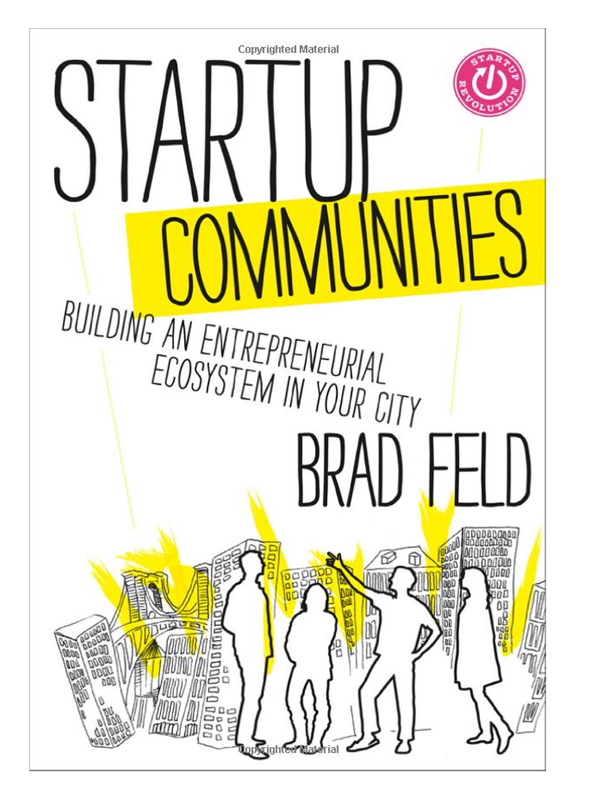
Some of the possible answers to that question is explained within an excellent new book by Brad Feld, a start-up founder, blogger and venture capitalist from Boulder.
“Start-Up Communities” is the story of how entrepreneurs within his community have created a new type of ecosystem where they, and not large companies or government, are driving the local economic agenda through a whole range of projects.
And, as Feld explains in the wonderful sketchbook below from the Kauffman Institute, there are essentially four lessons to be learnt from Boulder’s experiences.
First of all, there are two types of people within entrepreneurial communities namely leaders (entrepreneurs) and feeders (people who support startups, such as government agencies, funders, service providers and universities). However, any new developments must be led by entrepreneurs and supported by the other actors within the local business community who feed into the system.
Secondly, a successful entrepreneurial community cannot be built overnight and there must be a long view and commitment to enabling this to happen over a period of at least twenty years embracing, over time, both success and failure.
Thirdly, there must be an environment of inclusivity where anyone with an interest in entrepreneurship is welcome to contribute to the process.
And finally, there must be various substantive activities that engage the entire business community to help start ups to develop. These include the Boulder Open Coffee Club, which brings together a group of people who are interested in entrepreneurship and technology to have coffee every other week before work and to discuss issues related to start-ups. And Startup Weekend, which started in Boulder to bring together a group of developers, business managers, start-up supporters, marketing gurus and graphic artists to create new companies and is now replicated in cities around the world.
Of course, another key driver in cementing the reputation of the city as a location for technology start-ups has been Techstars, co-founded by Feld. I would argue that it is probably the most successful start-up accelerator programme in the World, having funded eighty seven companies that have received $194 million of investment and created 841 jobs.
Clearly, this entrepreneurial ecosystem not only helps develop new businesses but, more importantly, is a key economic influencer on the economy of the whole city. Indeed, Feld’s description of an entrepreneur-led cluster of start-ups is in contrast to the many examples of top down government-managed programmes to support economic development found elsewhere.
In the book, he notes that whilst entrepreneurs work in a bottom-up networked world, governments remain ensconced in a command and control culture. Whilst governments take time to implement new ideas, entrepreneurs want immediate action.
And certainly, rather than waiting for government to act, entrepreneurs like Brad Feld have taken the initiative to turn this sleepy Rocky Mountains city into an entrepreneurial powerhouse that is the envy of much larger metropolitan areas around the World.
But to me, the most important statement from the book is about how the entrepreneurs of Boulder are proud of their achievements and see themselves as cheerleaders for the success of their businesses and the city.
As Feld notes “These cheerleaders are both the leaders and the feeders as everyone in the community should be proud of what they are doing and shout it from the rooftops. This cheerleading can be via a community website…or it can be regular, steady blogging, writing and talking that we have in Boulder by the individual leaders and feeders. Regardless – be proud of what you are doing in your community, and make noise about it to the world.”
That is certainly a key message for entrepreneurs in Wales and if cities like Cardiff and Swansea are to emulate the success of a small city like Boulder, then celebrating entrepreneurship wouldn’t be a bad place to start.
Monday, May 21, 2012
KAUFFMAN, START-UP ACTS AND LESSONS FOR GOVERNMENT
Last week, during an eight day visit to the United States, I paid a visit to the Ewing Marion Kauffman Foundation in Kansas City, Missouri.
Established in the 1960s by a local entrepreneur, it is now one of the thirty largest foundations in the USA with an asset base of around $2billion. More relevantly, it is focuses its activities on specifically advancing entrepreneurship and improving the education of children and youth.
In terms of the former, the Foundation works with leading educators, researchers and other partners to further understanding of the powerful economic impact of entrepreneurship and to improve the environment in which entrepreneurs start and grow businesses. It also develops programmes to train the nation’s next generation of business leaders through enhancing entrepreneurial skills and abilities.
Needless to say, the meetings we had with their research, policy and training divisions were extremely useful and whilst Kauffman does focus its efforts solely within the United States, it welcomed the opportunity to work with a small nation such as Wales in the future.
However, it is not only Wales that can learn from the Kauffman Foundation and its focus on delivering a more entrepreneurial economy should strike a chord with politicians and policymakers in the UK Government. Certainly, with the economy still stuttering, it is clear that government can, and must, play a bigger role in stimulating entrepreneurial activity to create wealth and jobs.
In particular, there needs to be more high growth sustainable businesses created within the economy. To achieve this goal, there needs to be a continuous stream of new ideas capable of being commercialised, more bold entrepreneurs who can launch and build new twenty-first-century companies, fewer roadblocks to the launch and growth of these new enterprises, and low-cost capital available to finance them.
However, there seems to be little impetus to support more new firms within the USA, despite the evidence on their role in the economy. For example, nearly all of the new jobs created in the US economy have come from businesses that are less than five years old. More importantly, a disproportionate number of innovations during the last decade have been commercialised by new firms.
This policy vacuum by the political leaders of America has led to the Kauffman Foundation proposing a "Startup Act" to jump-start the U.S. economy and increase job creation by accelerating the growth of new and young businesses.
Some of the changes in government policy proposed by this act include welcoming immigrants capable of building high-growth companies to the United States by providing "Entrepreneurs' visas" and green cards for those with degrees in science, technology, engineering and mathematics. This is plain common sense, given that research has shown that non-Americans have founded over half of the new firms in Silicon Valley and that a disproportionate number of the 500 largest U.S. public companies were created by immigrants or the children of immigrant founders.
The Act also recognises that new, growing firms often require outside capital, in the form of both equity and debt. This is especially true for firms in capital-intensive businesses in fast growing knowledge-based sectors such as alternative energy or aspects of life sciences. It therefore proposes that any long term investments in start-ups should be free from capital gains to differentiate it from other forms of personal investments. It also suggests, to deal with the cashflow difficulties that many new firms face in their earlier years, that they should be excluded from corporate tax in the first year of taxable profits, with a 50 per cent reduction in the next two years.
Finally, there is a recognition that many new firms are faced with a disproportionate amount of regulatory burden. The Act therefore proposes that such barriers to the formation and growth of new firms can be reduced ensuring that all business regulation lapses automatically after ten years unless it is reproposed and implemented. In addition, common sense and cost-effective standards for regulations should be introduced, and a regular assessment made of state and local startup policies.
The Kauffman Foundation still has a long way to go before it ensures that such proposals become real but the job creating potential of new firms is something that policymakers in the UK, at both national and devolved levels of government, need to recognise.
Whilst much of the focus of the industrial policy in Westminster and Cardiff Bay has been on supporting larger companies, the real job creators in the economy have yet to be appreciated by our politicians. Whether the UK needs its own Startup Act is open to question but it certainly needs Government to make it easier for entrepreneurs to set up new firms and, more importantly, to put policies in place that enable them to oo sustainably over the long term.
Labels:
Entrepreneurship,
Kauffman,
start-ups
Monday, January 23, 2012
WALES NEEDS NEW FIRMS NOT WHITE ELEPHANTS
As governments around the World look to reignite their economies, there is increasing interest in developing policies to encourage greater entrepreneurship. This is not surprising given that a range of studies have demonstrated the impact of both new and small firms on the economic prosperity of many nations.
Earlier this week, a major study from the European Commission showed that 85 per cent of net new jobs created in Europe between 2002 and 2010 came from small and medium sized enterprises (SMEs), far higher than their 67 per cent share of total employment. That, in itself, shows the vital importance of small firms at this critical time for Europe.
However, the one statistic that screams out for politicians to take notice and reach out for new policies immediately is the finding that all net employment growth has been generated by newly born SMEs (i.e. those aged up to five years old). In fact, the number of jobs created by new firms – 17.5 million - more than compensated for the 8.9 million jobs lost through business failure.
In contrast, employment in businesses over ten years old declined by seven per cent over the same period. This is a critical finding and demonstrates unequivocally that entrepreneurship, rather than large firm expansion, is key to the job creation potential of the Welsh economy. More importantly, entrepreneurial activity is not limited to a small number of people.
According to the latest edition of the Global Entrepreneurship Monitor (GEM) released on Thursday, it is estimated that 388 million entrepreneurs were actively engaged in starting and running new firms in 2011. And who are these entrepreneurs?
The average profile of the individual running new businesses remains largely unchanged from previous GEM studies. Through a survey undertaken in fifty-four countries, the results showed that most were often young to middle-aged (25-44 years) although there is a tendency toward younger entrepreneurs in many developing economies. In terms of gender, they tend to be overwhelmingly male although it does vary by nation.
For example, Singapore and Switzerland have comparatively high levels of female participation in entrepreneurship whilst only one in four of the entrepreneurs in France and the Republic of Korea are women.
The GEM study also confirms the findings of the European study in that new firms are job creators, with 141 million early-stage entrepreneurs expecting to create at least five new jobs in the next five years. Given this, it is not surprising that a proportion are also innovative and export-driven - 69 million new firm creators are involved in developing new products and services and 18 million sell at least a quarter of what they produce to international markets.
So what does this mean for policymakers in Wales and the UK? Certainly, it is time for politicians to start walking the talk if the economy is going to recover from its current doldrums during the next 12-18 months.
The Westminster Government should continue with programmes such as UK Start-Up to encourage a greater number of new businesses. But there needs to be more urgency to ensure a greater focus by legislators on reducing red tape and simplification. In particular, ensuring that the needs of new and small firms are taken into consideration when any laws or regulations are developed is critical.
There is also a desperate requirement for better long-term finance for new firms, something that has been sadly missing since the banking crisis despite the efforts of the Coalition government through the Merlin project. In Wales, the recently published report on micro-businesses is a step in the right direction and some of the recommendations could make a real difference. But whilst it is a valuable study in itself, it mainly deals with the issues of firms already in existence rather than addressing how a greater number of new businesses can be created and supported.
And as this blog has been stating time and time again during the last eight years, Wales, through its Entrepreneurship Action Plan (EAP), already has the structure and strategy that is light years ahead of anything else globally in terms of driving forward the creation of an enterprise culture. Through the implementation of that plan between 2000 and 2004, the number of new firms increased considerably in Wales and, not surprisingly, so did private sector employment.
And this was not done by concentrating on a ‘picking winners’ strategy of focusing on high growth start-ups, as the Welsh Government has recently adopted but by developing an enterprise culture in which more people would be encouraged to start a new business.
Unfortunately, the EAP was abandoned in 2005 by a Government that was more in favour of a “Fields of Dreams” strategy which focused on building expensive white elephants such as Techniums rather than having a comprehensive approach to developing an entrepreneurial nation rich in new employment opportunities.
And whilst attracting inward investment is of some importance to Wales, encouraging more entrepreneurs is more critical to the nation’s future, an issue that the Institute of Welsh Affairs seems to have singularly ignored as part of the theme of its third Welsh Economy conference in March.
More importantly, if the new Minister, as she has stated on numerous times, is focused predominantly on creating new jobs, then with the evidence showing that the vast majority of these come from start-ups, it is surely time for the resurrection of the EAP to create more new firms, and therefore more wealth and prosperity, in the Welsh economy.
Wednesday, December 21, 2011
START-UP SAUNA
Given my love for all things Finnish, this is one new programme that policymakers could and should be emulating.
The Aalto Venture Garage, part of the newly formed Aalto University, is a co-working space and seed accelerator in the Nordics and Baltics, providing a free 700m open space for hackers and startups. It operates from a big industrial hall whose interiors have been optimised for entrepreneurs to work together. Shipping containers have also been brought in to create extra rooms, with even their roofs being transformed into office space, with stairs leading to the top and onto a maze of chairs and tables.
Its programmes include the Startup Sauna, which claims to be the leading open sourced seed accelerator for early-stage startups in Northern Europe and Russia. Startup Sauna pushes the selected startups develop to a stage where they are ready to take over the international markets, using coaching from some of the region’s best serial entrepreneurs, investors and other professionals.
Labels:
Entrepreneurship,
Finland,
start-ups
Subscribe to:
Posts (Atom)